by nicholas diodato
The first time I ever contacted a Senator was with Senator Cory Booker. I was assisting Rutgers to ensure that federal funding continues to our school, so that underprivileged students can get financial aid. Rutgers made a call for action by asking students to reach out to their senators to ask them to stop President Trump’s administration from halting federal. This shifts the focus to what Congress says about the people it represents. I received a detailed response from our Senator on how he has been trying to combat affordable education, as shown below:

While this isn’t earth-shattering political action, one thing becomes clear. In an era where trust in the federal government is at an all-time low, politics is not about making sweeping changes in one swift move. It’s about doing what you can with the resources you have access to.
Politics is, in many ways, broken; my family doesn’t feel it’ll ever receive proper treatment in this country. My partner is entering the medical field but feels that healthcare is overpriced and poorly understood by the general population. Politics is personal and runs so deep, but how does that reflect in my exchange with my Senator? And what does political interaction look like beyond emails?
Protests are often a go-to means for citizens to assert their rights as U.S. citizens. One amazing example of this is the Chicago Freedom Movement, led by civil rights leaders Dr. Martin Luther King Jr., Al Raby, and James Bevel. This movement acted against the racial discrimination within the residenies of Chicago, due to redlining, which refused minority families housing and economic opportunities in the city, such as financial institutions not lending to families. These leaders knew that to effect true legislative change, they had to protest by holding rent strikes, boycotting banks that discriminated against African Americans, and hosting workshops for youth on the principles of non-violent activism.
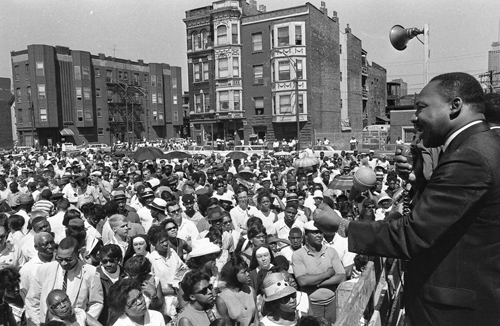
Photo Courtesy of Oxford African American Studies Center
By protesting en masse, the minorities in Chicago were heard. Mayor Richard Daley agreed to meet with Dr. Martin Luther King Jr., and policies were implemented to address discriminatory housing practices in Chicago. Two years later, the Fair Housing Act was introduced into federal law, with this movement being a core contributor.
This movement showcased a clear goal: to highlight the racial inequality that people of color face while trying to find opportunities in America. The organizers understood the structure through which to enact change, utilizing community gatherings and protests, and were able to get policymakers to take notice. This movement was effective because it had a clear structure. While Dr. Martin Luther King Jr. had already gained notoriety through his previous advocacy work, the Chicago movement highlights the importance of local politics and serves as another clear example that, in politics, one does what one can to effect change. Redlining still exists through zoning policies; it’s not a problem that went away. So why do this?
There were detractors of the policies that were passed after the Chicago Freedom Movement. Claims that it wasn’t enough. To this, Dr. King said that this movement “(is) the first step in a thousand-mile journey.” This is all a process of reducing the horrors of our past. To rid ourselves of systemic racism, gain healthcare accessibility, and have a truly democratic society, we must sink time and be critical of any injustice. This is not something that ends with Rutgers Democracy Lab; it doesn’t even end when every member of Gen Z is dead. It ends when our nation has proper civics education, accessible to all Americans, and we know how to push the boundaries of government by understanding our needs as citizens. For now, though, we follow under-exposed government websites and hope our nation will learn that true democracy comes from action and transparency.
Below, I have provided links to websites that can help you take the next step in this thousand-mile journey.
USA.gov officials search allows you to find federal, state, and local government officials, along with their contact information.
Senate.gov enables you to locate your federal senators and provides their contact information.
Municode Codification enables anyone to view the local policies and Municipal codes being implemented in their district.
Walton Options: Systems Advocacy is an effective guide to writing to our government officials.
The Muncipial Research and Services Center is a non-profit that provides legal and policy guidance for those dealing with local government
 nicholasdiodato.com